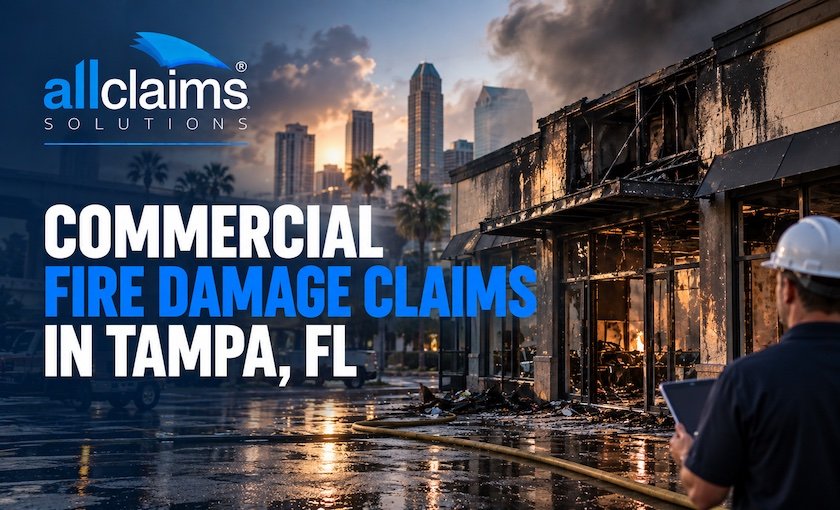
A commercial fire can affect far more than the part of a building where the flames occurred.
For a Tampa business owner, a fire can result in damage to the building, equipment, inventory, furniture, electrical systems, computers, documents, and other business property. Smoke and soot can spread well beyond the area directly affected by flames, while water used to extinguish the fire can create additional property damage.
At the same time, the business may be unable to operate normally.
That can create a second financial problem: lost income and additional expenses associated with the interruption of business operations.
Commercial fire damage insurance claims can therefore be considerably more complex than simply estimating the cost of repairing the burned area.
A comprehensive claim may need to account for multiple categories of physical damage and, depending on the policy, financial losses associated with the interruption of business operations.
At All Claims Solutions, we help Tampa business owners navigate complex property insurance claims, including commercial fire, smoke, water, and business interruption losses.
What Is a Commercial Fire Damage Insurance Claim?
A commercial fire damage claim is a request for benefits under a commercial property insurance policy after a business experiences a covered fire-related loss.
Depending on the policy and circumstances, a commercial fire claim may involve damage to:
- The building
- Roofing
- Walls and ceilings
- Electrical systems
- Plumbing
- HVAC systems
- Machinery
- Equipment
- Furniture
- Computers and electronics
- Inventory
- Supplies
- Documents and records
- Signage
- Exterior property
- Other business-owned property
It may also involve smoke and soot damage, water damage from firefighting efforts, and business income losses when applicable coverage exists.
Commercial policies vary significantly. The Florida Department of Financial Services notes that commercial property policies can contain different coverages, endorsements, exclusions, and limits depending on the policy and insurer.
What Does Commercial Fire Insurance Cover?
There is no single answer that applies to every Tampa business.
Commercial property policies are contracts, and coverage depends on the specific policy, cause of loss, exclusions, limits, deductibles, endorsements, and circumstances surrounding the fire.
Depending on the policy, a commercial fire claim may involve several categories of damage.
1. Building Damage
The most obvious category is physical damage to the building.
This may include:
- Roof damage
- Walls
- Ceilings
- Flooring
- Doors
- Windows
- Framing
- Electrical systems
- Plumbing
- HVAC
- Built-in fixtures
- Interior finishes
The extent of covered building damage depends on the policy and the circumstances of the loss.
2. Smoke and Soot Damage
A fire does not have to directly burn an item for it to be affected.
Smoke and soot can spread throughout a commercial property, contaminating:
- Walls
- Ceilings
- Flooring
- Furniture
- Equipment
- Inventory
- Electronics
- HVAC systems
- Documents
- Merchandise
Smoke odors and residues can also remain after the visible fire has been extinguished.
This is why a commercial fire damage inspection should look beyond the area where flames were visible.
3. Water Damage From Firefighting
Fire suppression can create significant secondary damage.
Firefighters may use large quantities of water to extinguish the fire, potentially affecting:
- Flooring
- Walls
- Ceilings
- Electrical equipment
- Inventory
- Furniture
- Machinery
- Stored materials
- Other business property
A commercial fire claim may therefore involve fire, smoke, soot, and water damage simultaneously.
The cause of each category of damage and the applicable policy provisions should be evaluated carefully.
4. Business Property and Equipment
A fire can damage much more than the physical structure.
Depending on the policy, commercial property coverage may also apply to eligible business personal property.
Examples include:
- Computers
- Servers
- Office furniture
- Machinery
- Tools
- Restaurant equipment
- Manufacturing equipment
- Point-of-sale systems
- Security systems
- Electronics
- Specialized equipment
For many businesses, replacing equipment can represent a significant portion of the total claim.
5. Inventory and Merchandise
Retailers, restaurants, distributors, manufacturers, and other businesses may have substantial inventory at the time of a fire.
Potentially affected items can include:
- Merchandise
- Raw materials
- Finished products
- Food
- Packaging
- Supplies
- Stored inventory
Smoke, heat, soot, water, and contamination may affect inventory even when flames did not directly reach it.
A detailed inventory is therefore essential.
6. Business Income and Business Interruption
One of the most financially significant aspects of a commercial fire can be the interruption of normal business operations.
If a covered property loss forces a business to close or significantly reduce operations, business income coverage may provide benefits for qualifying losses, subject to the policy.
The Florida Department of Financial Services explains that business income insurance can cover a reduction in income for a specified period when operations are interrupted because of damage to property caused by a covered peril.
Depending on the policy, this coverage can be critical for businesses that cannot immediately return to normal operations.
What Is Extra Expense Coverage?
Some commercial policies also include extra expense coverage.
This can help cover certain additional expenses incurred to continue business operations after a covered loss.
Examples can include:
- Temporary relocation
- Renting temporary equipment
- Temporary office space
- Additional operating expenses
- Costs associated with maintaining operations elsewhere
The Florida Department of Financial Services describes extra expense coverage as coverage for additional expenses incurred to continue normal operations after a covered loss, such as relocating temporarily or leasing additional equipment.
The available coverage and limits depend on the policy.
Fire Damage Can Create Multiple Insurance Claim Categories
A commercial fire claim is rarely limited to one type of damage.
For example, imagine a restaurant in Tampa experiences an electrical fire.
The fire damages part of the kitchen.
But the overall loss may include:
Fire damage
→ Kitchen walls, ceilings, equipment
Smoke damage
→ Dining area, furniture, HVAC
Water damage
→ Floors and equipment from firefighting
Business property damage
→ Computers, POS equipment, furniture
Inventory loss
→ Food and supplies
Business interruption
→ Lost revenue while the restaurant cannot operate
Extra expenses
→ Temporary location or replacement equipment, if covered
Looking only at the visibly burned area could therefore significantly underestimate the overall claim.
What Should a Tampa Business Owner Do After a Fire?
The first priority should always be safety.
Once the property is safe to access, careful documentation becomes extremely important.
1. Contact emergency services
Make sure the fire is fully extinguished and follow instructions from fire officials before entering the property.
2. Document the damage
Take photographs and videos of:
- Exterior damage
- Interior damage
- Fire damage
- Smoke damage
- Water damage
- Equipment
- Inventory
- Furniture
- Structural damage
- Electrical systems
- Other affected property
Document the property before extensive cleanup or repairs whenever it is safe and practical to do so.
3. Protect the property from additional damage
Reasonable temporary measures may be necessary to prevent additional damage.
Examples can include:
- Boarding openings
- Covering exposed areas
- Removing standing water
- Protecting undamaged inventory
- Securing the property
Keep documentation and receipts for emergency work and expenses.
4. Notify the insurance company
Review the policy’s reporting requirements and report the loss promptly.
Florida law currently generally requires notice of a property insurance claim within one year after the date of loss, while a supplemental claim generally has an 18-month notice period, subject to the statute, policy terms, and applicable circumstances.
Do not wait until the deadline approaches.
Create a Commercial Fire Damage Inventory
One of the biggest mistakes a business can make after a fire is failing to create a comprehensive inventory.
Do not focus only on items that were completely destroyed.
Create categories for:
Building
- Roof
- Walls
- Ceilings
- Flooring
- Doors
- Windows
- Electrical
- Plumbing
- HVAC
- Fixtures
Equipment
- Machinery
- Computers
- Servers
- Appliances
- Tools
- Specialized equipment
Inventory
- Merchandise
- Raw materials
- Finished products
- Food
- Supplies
Contents
- Furniture
- Office equipment
- Documents
- Electronics
- Other business property
For each item, document what you can about:
- Description
- Quantity
- Age
- Original cost
- Replacement cost
- Condition
- Location
- Photographs
- Proof of ownership
Keep Your Business Records
Business records can become extremely important when a fire claim includes business income or interruption losses.
Preserve relevant records such as:
- Financial statements
- Sales reports
- Tax records
- Payroll records
- Bank statements
- Point-of-sale records
- Inventory records
- Purchase invoices
- Vendor records
- Historical revenue
- Operating expenses
- Lease documents
These records can help establish the financial impact of the interruption.
How Is Business Interruption Loss Calculated?
Business interruption claims can be more complicated than simply calculating the number of days a business was closed.
Depending on the policy, the analysis may involve:
- Historical revenue
- Expected revenue
- Actual revenue
- Continuing expenses
- Payroll
- Operating expenses
- Seasonal fluctuations
- Business trends
- The period required to restore operations
- Other policy-specific factors
Commercial policies may also contain specific limits, waiting periods, valuation provisions, or maximum periods of indemnity.
The Florida Department of Financial Services notes that business income coverage may have maximum monthly limits and a maximum period of indemnity.
How Long Does a Commercial Fire Insurance Claim Take?
There is no universal timeline.
A relatively small claim may be resolved more quickly than a major commercial fire involving structural damage, specialized equipment, inventory, and business interruption.
Factors that can affect the timeline include:
- Extent of physical damage
- Cause-of-loss investigation
- Building repairs
- Engineering inspections
- Inventory valuation
- Equipment replacement
- Contractor estimates
- Business income calculations
- Policy interpretation
- Coverage disputes
- Documentation
- Communication between the parties
Large commercial losses can require significant documentation before the full scope of the claim is established.
What If the Insurance Company Underestimates the Fire Damage?
An initial insurance estimate may not necessarily represent the complete scope or final cost of a commercial fire loss.
Additional issues can become apparent as:
- Damaged materials are removed
- Smoke contamination is evaluated
- Equipment is tested
- Structural components are inspected
- Contractors develop detailed scopes
- Inventory is fully documented
- Business interruption losses are calculated
If additional covered damage or costs are identified, the claim may require additional documentation or a supplemental claim.
Florida law defines a supplemental claim as a claim for additional loss or damage from the same peril that the insurer previously adjusted, or costs incurred while completing repairs or replacement under an open claim for which timely notice was previously provided.
What If a Commercial Fire Insurance Claim Is Denied?
A commercial fire claim may be denied or limited for various reasons.
For example, the insurer may argue that:
- The loss is excluded
- The damage was caused by a different peril
- The policy does not provide the requested coverage
- The damage is not sufficiently documented
- The claimed amount is unsupported
- The business interruption calculation is incorrect
- A policy condition was not satisfied
- Certain property is subject to a coverage limitation
If your claim is denied, review the insurer’s written explanation carefully.
Pay attention to:
- The reason for denial
- The policy language cited
- Applicable exclusions
- Coverage limits
- Deductibles
- Endorsements
- The insurer’s estimate
- Missing documentation
A denial is not something a business owner should simply ignore.
What If the Commercial Fire Claim Is Underpaid?
Underpayment can occur when the insurer’s estimate does not adequately account for the scope of covered damage.
This can happen with complex losses involving:
- Structural repairs
- Specialized equipment
- Smoke remediation
- Water damage
- Inventory
- Building code-related work where applicable
- Business interruption
- Extra expenses
- Additional repair requirements
If the claim appears incomplete, compare the insurer’s estimate with the actual scope of work and supporting documentation.
Can a Public Adjuster Help With a Commercial Fire Claim?
A licensed public adjuster represents the policyholder, not the insurance company.
Florida’s Department of Financial Services explains that public adjusters can assist policyholders with preparing and presenting property insurance claims.
A public adjuster may be particularly useful for a commercial fire when the claim involves:
- Extensive structural damage
- Smoke and soot contamination
- Water damage
- Equipment losses
- Inventory
- Business interruption
- Extra expenses
- Multiple areas of the property
- A denied or underpaid claim
- Complex policy provisions
The role is not to guarantee a particular settlement.
The objective is to help the policyholder document, prepare, present, and negotiate the claim based on the policy and available evidence.
Why Commercial Fire Claims Can Be More Complex Than Residential Claims
A residential fire claim may primarily involve a home and personal belongings.
A commercial fire can involve several interconnected financial and operational components.
For example:
Building
+
Business Property
+
Equipment
+
Inventory
+
Smoke/Soot
+
Water Damage
+
Business Income
+
Extra Expense
This makes comprehensive claim preparation particularly important for business owners.
Commercial Fire Claims for Different Tampa Businesses
Fire losses can affect virtually any type of commercial property.
Restaurants
Potential losses can include:
- Cooking equipment
- Refrigeration
- Food inventory
- HVAC
- Kitchen systems
- Furniture
- Smoke contamination
- Lost business income
Retail Stores
Potential losses may include:
- Merchandise
- Displays
- POS systems
- Fixtures
- Inventory
- Building components
- Business interruption
Offices
Potential losses may involve:
- Computers
- Servers
- Furniture
- Documents
- Communications systems
- Interior finishes
- Temporary relocation expenses
Warehouses
Potential losses can involve:
- Stored inventory
- Racking
- Forklifts
- Equipment
- Building systems
- Roofing
- Structural components
Industrial Facilities
Large industrial fire claims can involve highly specialized equipment, machinery, production systems, inventory, and significant business interruption losses.
These claims may require detailed documentation and coordination among multiple professionals.
Commercial Fire Damage Claims After an Electrical Fire
Electrical fires can create unique challenges.
The visible fire damage may be only part of the loss.
The investigation may also involve:
- Electrical panels
- Wiring
- Machinery
- Appliances
- Computers
- HVAC systems
- Power systems
- Surge-related damage
- Smoke contamination
Determining the origin and cause of the fire may also be important to the insurance claim.
Business owners should avoid making assumptions about coverage or liability before the cause-of-loss investigation is complete.
Don’t Overlook Smoke and Soot Damage
One of the most common mistakes after a commercial fire is focusing exclusively on burned areas.
Smoke can travel through:
- HVAC systems
- Ductwork
- Wall cavities
- Ceilings
- Open spaces
Soot can settle on surfaces far from the original fire.
For a business, this may affect equipment, merchandise, furniture, electronics, and other property.
A complete inspection should therefore evaluate the entire affected property, not simply the location where the fire started.
Commercial Fire Damage Claim Checklist
After a commercial fire, use this checklist to organize your claim:
☐ Ensure the property is safe to enter
☐ Obtain the fire department report when available
☐ Photograph and video all visible damage
☐ Document smoke and soot throughout the property
☐ Document water damage from firefighting
☐ Create an inventory of damaged business property
☐ Document damaged equipment
☐ Document damaged inventory
☐ Preserve financial records
☐ Track business interruption
☐ Keep receipts for emergency expenses
☐ Make reasonable temporary repairs to prevent further damage
☐ Notify your insurance company promptly
☐ Review your commercial policy and endorsements
☐ Compare estimates and scopes of work
☐ Document additional damage discovered during repairs
☐ Consider professional claim assistance for complex losses
All Claims Solutions — Trusted Commercial Public Adjusters Serving Tampa, FL.
 201 E. Kennedy Blvd #1240, Tampa, FL 33602
 24/7 Assistance: (813) 368-5382
 tampa.allclaimssolutions.com
Frequently Asked Questions About Commercial Fire Damage Claims in Tampa
Many commercial property policies provide coverage for certain fire losses, but coverage depends on the specific policy, cause of loss, exclusions, limits, deductibles, and endorsements.
Smoke and soot damage may be covered when resulting from a covered fire, but the policy and circumstances of the loss determine coverage.
Water used to extinguish a covered fire can create significant property damage. Whether and how that damage is covered depends on the policy and the circumstances of the loss.
Business income coverage may cover qualifying income losses resulting from an interruption caused by covered physical damage. Coverage depends on the policy.
Extra expense coverage can help with certain additional expenses incurred to continue business operations following a covered property loss, such as temporary relocation or equipment rental.
Under current Florida law, a property insurance claim generally must be reported within one year after the date of loss, while a supplemental claim generally has an 18-month notice period. Policy requirements and applicable circumstances also matter.
Potentially. Florida law specifically provides for supplemental claims involving additional loss or damage from the same peril that was previously adjusted, or qualifying additional costs incurred while completing repairs under an open claim.
The board should compare the insurer’s estimate with the documented scope of damage and supporting estimates. For complex or disputed losses, professional claim assistance may help the association evaluate and present the claim.
It depends on the complexity of the loss. A public adjuster may be particularly useful for large commercial fires involving structural damage, equipment, inventory, smoke, water damage, business interruption, or a disputed claim.
Need Help With a Commercial Fire Damage Claim in Tampa?
A commercial fire can affect your building, equipment, inventory, operations, and revenue at the same time.
The visible damage is often only one part of the claim.
At All Claims Solutions, our licensed public adjusters help Tampa business owners document and navigate complex commercial property insurance claims, including:
- Fire damage
- Smoke and soot damage
- Water damage
- Commercial property damage
- Equipment losses
- Inventory losses
- Business interruption claims
- Additional expenses
- Denied and underpaid claims
We work for the policyholder—not the insurance company—and help manage the claim process from inspection and documentation through negotiation.
Has a Fire Damaged Your Tampa Business?
Get a Free Insurance Claim Evaluation →
If your association is dealing with a complex property loss, an underpaid claim, a denied claim, or questions about the scope of damage, contact All Claims Solutions to discuss your situation.
Call All Claims Solutions today for a free claim evaluation.
This article is for general informational purposes only and does not constitute legal, accounting, or insurance coverage advice. Property insurance coverage varies by policy, insurer, endorsements, exclusions, limits, deductibles, and the circumstances of the loss.
Types of Insurance Claims in Tampa FL
Water Damage >
Fire Damage >
Storm Damage >
Flood Damage >
Mold damage >
Structural Damage >