
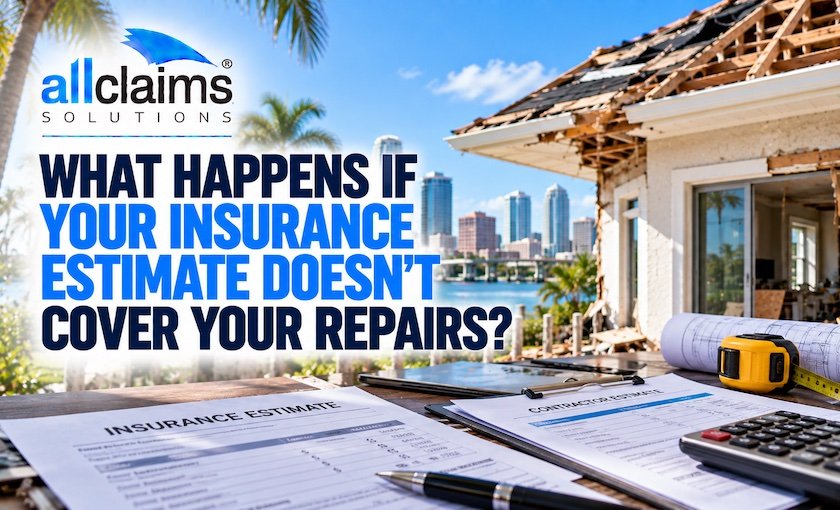
Receiving an insurance estimate can feel like the next step toward getting your property repaired. But what happens when the amount listed in the insurance estimate is significantly lower than the actual cost of repairing your home or business?
This situation can occur after water damage, storm damage, hurricane damage, fire, roof damage, or other covered property losses. A contractor may provide an estimate that is substantially higher than the amount included in the insurance company’s estimate.
That difference does not automatically mean that either estimate is correct.
The important question is whether the insurance estimate accurately reflects the covered damage, required repairs, appropriate materials, labor, and other costs allowed under the policy.
For property owners in Tampa, FL, understanding how to review this difference can help you determine what steps may be available before accepting an insurance payment or moving forward with repairs.
Why Might an Insurance Estimate Be Lower Than the Repair Cost?
An insurance estimate and a contractor’s estimate may differ for several reasons.
The insurance company’s estimate may not include every item necessary to restore the property, or the two estimates may use different assumptions about materials, labor, quantities, or the scope of work.
Some common reasons for a difference include:
1. Damage Was Not Fully Documented
If certain damage was not identified during the initial inspection, it may not appear in the insurance estimate.
For example, visible water damage may lead to additional damage behind walls, ceilings, flooring, or cabinets that becomes apparent only after materials are removed.
2. Some Repair Items May Be Missing
An estimate may include the primary repair but omit related work needed to complete the restoration.
Examples can include:
- Removal and disposal
- Drywall replacement
- Painting
- Flooring replacement
- Cabinet work
- Electrical work
- Plumbing-related repairs
- Additional labor
- Permits
- Matching materials
- Necessary reconstruction
Whether any particular item is covered depends on the facts of the loss and the insurance policy.
3. Different Materials May Be Included
The cost of restoring a property can vary significantly depending on the materials specified.
For example, replacing damaged flooring with a different material may produce a very different estimate from replacing it with the same or comparable material.
The Florida Department of Financial Services advises policyholders who disagree with an insurer’s settlement to review the insurer’s itemized estimate and make sure that the appropriate materials and all relevant evidence were considered.
4. Labor Costs May Differ
Construction and restoration costs vary by location, project complexity, labor availability, and current market conditions.
A contractor performing the work may identify labor requirements that are not reflected in the original insurance estimate.
5. Additional Damage May Be Discovered
Some property damage cannot be fully evaluated during the first inspection.
This is particularly relevant with:
- Water intrusion
- Roof leaks
- Storm damage
- Hurricane damage
- Fire and smoke damage
- Structural damage
As repairs begin, previously hidden damage may become visible.
That situation may require additional documentation and potentially a supplemental claim, depending on the circumstances and policy.
What Should You Do If the Insurance Estimate Is Too Low?
If the insurance estimate does not appear to cover the necessary repairs, do not simply assume that the difference is your responsibility.
Start by comparing the estimates carefully.
1. Request the Itemized Insurance Estimate
Ask the insurance company for the detailed estimate used to calculate the payment.
The estimate should allow you to identify what the insurer included and what may be missing.
Look for:
- Areas of damage
- Quantities
- Materials
- Labor
- Removal and disposal
- Repairs
- Replacement costs
- Applicable deductibles
- Depreciation, if applicable
- Any items specifically excluded or denied
The Florida Department of Financial Services specifically recommends requesting the insurer’s itemized repair estimate when a policyholder is dissatisfied with the settlement.
2. Compare It With the Actual Scope of Repairs
If you have a contractor’s estimate, compare it line by line with the insurance estimate.
Do not focus only on the final dollar amount.
Instead, ask:
What work is included in one estimate but missing from the other?
For example:
| Repair Item | Insurance Estimate | Contractor Estimate |
|---|---|---|
| Roof repairs | Included | Included |
| Interior drywall | Partial | Full replacement |
| Flooring | Not included | Included |
| Painting | Partial | Full restoration |
| Debris removal | Included | Higher quantity |
| Additional electrical work | Not included | Included |
A comparison like this can reveal where the difference comes from.
What If the Contractor Estimate Is Higher Than the Insurance Estimate?
A higher contractor estimate does not automatically mean the insurance company owes the difference.
The contractor and insurer may have different opinions about:
- The cause of damage
- The scope of damage
- The appropriate repair method
- The materials required
- Labor quantities
- What is covered by the policy
- Whether certain damage is related to the covered loss
The key issue is whether the additional work is supported by the damage, the repair requirements, and the insurance policy.
This is why simply submitting a larger contractor estimate may not resolve the disagreement.
The supporting documentation matters.
Can You Ask the Insurance Company to Reconsider the Estimate?
Yes.
If you believe the estimate does not accurately reflect the covered loss, you can communicate your concerns to the insurance company and provide supporting documentation.
Florida’s Department of Financial Services recommends that policyholders who disagree with an offered settlement communicate their concerns to the insurer, provide an alternative estimate when appropriate, and submit photographs, videos, receipts, and other evidence that may not have been considered.
Your documentation may include:
- Contractor estimates
- Photographs
- Videos
- Receipts
- Invoices
- Measurements
- Inspection reports
- Engineering reports, when applicable
- Roof inspection reports
- Restoration company documentation
- Records showing damaged or discarded materials
Keep copies of everything submitted.
What If the Insurance Company Still Won’t Cover the Full Repair Cost?
If you have provided documentation and still disagree with the amount offered, the next step depends on the specific circumstances of the claim.
Possible situations include:
The claim may be underpaid
An underpaid insurance claim occurs when the insurer accepts that a covered loss exists but the payment does not adequately reflect the covered damage or repair scope.
This is different from a denied claim, where the insurer does not agree to pay the claim or a portion of it based on coverage or another issue.
Additional damage may need to be addressed
If additional damage from the same loss is discovered while an existing claim is being handled, the situation may potentially involve a supplemental claim, depending on the circumstances and policy.
Florida law currently provides that supplemental property insurance claims generally must be noticed within 18 months after the date of loss, while an initial or reopened claim generally must be noticed within 1 year, subject to the statute and applicable policy terms.
Because deadlines and claim circumstances can vary, property owners should not wait until repairs are complete before determining what documentation and notice may be required.
The claim may need further review
In some situations, a property owner may benefit from having the claim and supporting documentation reviewed by a licensed professional who represents the policyholder.
Should You Repair the Property Before the Insurance Dispute Is Resolved?
Not necessarily.
The appropriate approach depends on the type and severity of the damage.
If immediate action is necessary to prevent further damage or protect occupants, reasonable temporary repairs may be appropriate. Keep photographs, receipts, invoices, and other documentation of the work.
For larger repairs, property owners should understand what the policy requires and communicate with the insurer before making major decisions whenever practical.
This is especially important when the repair process could expose additional damage that was not visible during the initial inspection.
What Is the Difference Between an Insurance Estimate and a Contractor Estimate?
The two estimates serve different purposes.
Insurance estimate
An insurance estimate is generally prepared to evaluate the cost associated with the loss and determine the insurer’s payment under the applicable policy.
Contractor estimate
A contractor’s estimate is focused on the work the contractor believes is necessary to complete the repair or restoration.
Neither estimate automatically determines what the policy covers.
The insurance contract, the documented damage, the cause of loss, and the applicable coverage provisions all matter.
What If the Insurance Estimate Misses Hidden Damage?
Hidden damage can become especially important during restoration.
For example, a water loss may initially appear to involve only a damaged ceiling. Once the affected materials are opened, additional damage may be discovered in insulation, framing, drywall, flooring, cabinetry, or other areas.
Similarly, after a storm, damage to roofing materials may reveal problems underneath the visible surface.
When additional damage is discovered, document it before disturbing the affected area whenever reasonably possible.
Take:
- Photos
- Videos
- Measurements
- Contractor notes
- Repair estimates
- Invoices
- Inspection reports
The additional damage should then be evaluated in relation to the original loss and the policy.
What About Roof, Water, Fire, and Hurricane Claims in Tampa?
The same basic issue can arise across many different types of property insurance claims.
Roof damage
A roof estimate may not account for every component necessary to restore the affected area.
Learn more: [Roof Damage Claims in Tampa, FL]
Water damage
Water losses can involve hidden damage that becomes visible during demolition or drying.
Learn more: [Water Damage Insurance Claims in Tampa, FL]
Hurricane and storm damage
Wind and storm losses may involve multiple areas of a property, including roofing, exterior structures, windows, ceilings, walls, and interior finishes.
Learn more: [Hurricane Damage Claims in Tampa]
Fire and smoke damage
Fire losses can involve structural repairs as well as smoke, soot, odor, water, and contents-related damage.
Learn more: [Fire Damage Claims in Tampa, FL]
When Should You Consider a Public Adjuster?
A property owner is not required to hire a public adjuster.
However, some property owners choose to work with one when the claim involves extensive damage, complicated documentation, disagreements about the scope of repairs, or a significant difference between the insurer’s estimate and the actual cost of restoration.
According to the Florida Department of Financial Services, a public adjuster represents the policyholder rather than the insurance company and can assist with preparing and presenting an insurance claim. Public adjusters must be licensed by the Florida Department of Financial Services.
A public adjuster may help with areas such as:
- Documenting property damage
- Reviewing the insurance estimate
- Preparing claim documentation
- Identifying potentially overlooked damage
- Evaluating repair and replacement costs
- Communicating with the insurer
- Presenting the policyholder’s position regarding the claim
Hiring a public adjuster does not guarantee a particular settlement amount. The outcome depends on the policy, facts, coverage, documentation, and circumstances of the claim.
Before hiring any public adjuster, Florida DFS recommends verifying the professional’s license and reviewing the contract and fees carefully.
What Not to Do When Your Insurance Estimate Is Too Low
Avoid making decisions based only on the difference between two dollar amounts.
Don’t assume the insurer’s estimate is automatically final
An estimate is part of the claim evaluation. If you believe it is incomplete, review the details and provide supporting evidence.
Don’t assume the contractor’s estimate is automatically covered
A contractor’s estimate may include work that is not covered under the policy.
Don’t discard damaged materials without documenting them
Photographs, videos, and records can be important evidence.
Don’t ignore additional damage
If new damage becomes visible during repairs, document it promptly.
Don’t wait unnecessarily
Florida property insurance claim deadlines can be important. Under current Florida law, initial and reopened claims generally have a one-year notice period, while supplemental claims generally have an 18-month notice period.
What Happens Next?
If your insurance estimate does not cover your repairs, the process does not necessarily end with the first payment.
A practical approach is:
1. Review the insurance estimate
↓
2. Compare it with the actual repair scope
↓
3. Identify missing or disputed items
↓
4. Gather supporting documentation
↓
5. Submit the information for review
↓
6. Determine whether additional claim action is appropriate
↓
7. Consider professional claim assistance when needed
The goal is not simply to obtain a higher estimate.
The goal is to determine whether the claim accurately reflects the covered damage and the costs necessary to restore the property according to the policy.
Get Help Reviewing an Insurance Claim in Tampa
If your insurance estimate does not appear to cover the cost of repairing your property, All Claims Solutions can help you understand the claim documentation and evaluate the scope of the reported loss.
Our licensed public adjusters represent policyholders—not insurance companies and can assist with documenting, preparing, and presenting property insurance claims.
Whether your property has experienced storm, hurricane, roof, water, fire, mold, or structural damage, a detailed claim review can help identify the information that may need further attention.
Get Your Free Insurance Claim Evaluation
ALL Claims Solutions – Tampa
📞 24/7: (813) 368-5382
📧 info@all-claims.com
🌐 tampa.allclaimssolutions.com
📍 201 E. Kennedy Blvd #1240, Tampa, FL
We Work for YOU, Not Insurance Companies.
No Recovery – No Fee.
Insurance coverage depends on the terms, conditions, exclusions, limits, deductibles, and circumstances of the applicable policy. This article is for general informational purposes and is not legal or insurance coverage advice.
Frequently Asked Questions
Compare both estimates line by line and identify differences in scope, materials, labor, quantities, and other repair items. You can provide the contractor’s estimate and supporting documentation to the insurance company for review.
A claim can be reviewed when additional information or documentation is provided. The insurer may re-evaluate the damage and estimate based on the information available.
You should review the insurer’s itemized estimate, compare it with the documented repair scope, and determine why the amounts differ. Depending on the circumstances, the claim may involve an underpayment, additional damage, or another coverage or scope dispute.
Potentially, depending on the circumstances, policy, and whether additional loss or damage from the same peril qualifies as a supplemental claim. Florida law currently provides an 18-month notice period for supplemental property insurance claims, subject to the statute and applicable policy terms.
A licensed public adjuster can represent the policyholder and assist with claim documentation, preparation, and presentation.
Not automatically. Coverage depends on the insurance policy and the facts of the loss. A difference between estimates should be evaluated based on the actual damage, required repairs, documentation, and applicable coverage.
No. An underpaid claim generally involves an insurer accepting some responsibility for a covered loss while the policyholder believes the payment is insufficient. A denied claim involves a disagreement in which the insurer does not agree to pay all or part of the claimed loss.
Need Help With Insurance Claim in Tampa?
Call All Claims Solutions today for a free claim evaluation.
This article is provided for general informational purposes only and does not constitute legal, accounting, tax, or insurance coverage advice. Commercial insurance coverage varies by policy, insurer, endorsements, exclusions, limits, deductibles, and the circumstances of the loss.
Types of Insurance Claims in Tampa FL
Water Damage >
Fire Damage >
Storm Damage >
Flood Damage >
Mold damage >
Structural Damage >