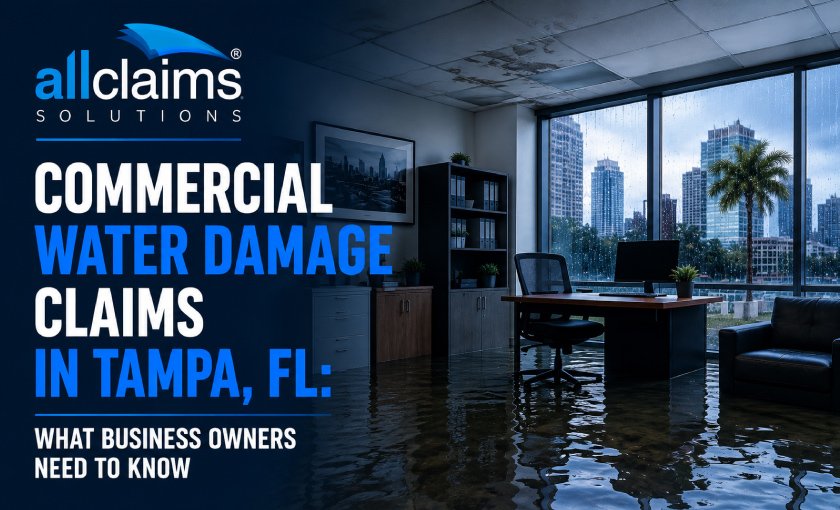
Water damage can be one of the most disruptive property losses a Tampa business can experience.
A burst pipe can flood an office overnight.
A plumbing failure can damage inventory.
A roof leak can affect equipment and electrical systems.
An HVAC or appliance failure can force a business to temporarily close.
For business owners, the problem isn’t only the cost of repairing the building.
Water damage can also affect:
- Equipment
- Inventory
- Furniture
- Computers
- Flooring
- Walls and ceilings
- Electrical systems
- Business operations
- Revenue
That’s why a commercial water damage insurance claim in Tampa, FL can be considerably more complex than a simple repair estimate.
At All Claims Solutions, our Public Adjusters help Tampa business and property owners document damage, prepare insurance claims, and navigate the claims process.
We Work for You—not the Insurance Company.
What Is a Commercial Water Damage Insurance Claim?
A commercial water damage insurance claim is a request for insurance benefits after a business property experiences water-related damage from a potentially covered cause of loss.
Commercial properties can experience water damage from many sources, including:
- Burst pipes
- Plumbing failures
- Roof leaks
- HVAC leaks
- Water heater failures
- Appliance failures
- Sprinkler system issues
- Accidental water discharge
- Storm-related water intrusion
However, the source of the water matters.
Commercial insurance policies can differ substantially in their covered causes of loss, exclusions, endorsements, deductibles, limits, and conditions. Florida’s Department of Financial Services specifically notes that commercial policies involve more varied forms and endorsements than personal policies.
That means a business owner should not assume that every type of water damage is automatically covered.
Does Commercial Insurance Cover Water Damage?
It may, depending on the policy and cause of loss.
Commercial property insurance can cover buildings and business property against certain covered causes of loss, but coverage depends on the specific policy.
For example, a sudden and accidental water loss caused by a covered event may potentially be treated differently from:
- Long-term leaks
- Maintenance issues
- Wear and tear
- Flooding
- Water intrusion from an excluded cause
- Repeated seepage
- Neglected plumbing problems
The policy language and facts surrounding the loss are critical.
Florida DFS emphasizes that commercial insurance policies and endorsements can vary between insurers and recommends reviewing the specific policy for coverage questions.
Common Causes of Commercial Water Damage in Tampa
Tampa businesses can experience water damage from many different sources.
1. Burst or Broken Pipes
A pipe failure can release a large amount of water in a short period.
This can damage:
- Drywall
- Flooring
- Ceilings
- Furniture
- Inventory
- Equipment
- Electrical components
A burst pipe can be particularly disruptive when it occurs after business hours.
2. Plumbing Leaks
Commercial plumbing systems can develop leaks behind walls, beneath flooring, or above ceilings.
A small leak may go unnoticed until significant damage has already occurred.
This makes documentation of the source, timeline, and resulting damage particularly important.
3. Roof Leaks
Tampa’s storms and heavy rainfall can expose weaknesses in commercial roofing systems.
A roof leak can result in:
Roof Damage
↓
Water Intrusion
↓
Ceiling Damage
↓
Wall Damage
↓
Equipment / Inventory Damage
↓
Business Disruption
This is why roof damage and interior water damage should often be evaluated together.
4. HVAC Water Damage
Commercial HVAC systems can produce water-related damage when components fail or drainage systems become blocked.
Potentially affected areas may include:
- Ceilings
- Walls
- Flooring
- Office equipment
- Inventory
- Furniture
5. Water Heater Failures
A failed commercial water heater can release significant amounts of water and affect multiple areas of a property.
6. Sprinkler System Damage
A malfunctioning sprinkler system can release substantial amounts of water.
The resulting claim may involve both:
- Building damage
- Business personal property
Water Damage vs. Flood Damage: Why the Difference Matters
One of the most important questions in a commercial water damage claim is:
Where did the water come from?
Water originating from a broken pipe inside a building can raise different coverage questions than water entering from an outside flood.
Florida’s Office of the Insurance Consumer Advocate warns that standard property policies generally do not cover flood damage and that separate flood insurance may be necessary.
For example:
Plumbing Failure
Broken pipe → Water enters building → Potential commercial property claim
versus:
Flooding
Rising surface water → Water enters building → May require flood insurance
The distinction can have a significant impact on the claim.
For this reason, our Tampa article “Water Damage vs. Flood Damage in Tampa, FL: What Does Insurance Cover?” should be linked prominently from this section.
What Can Water Damage Affect in a Commercial Property?
A complete commercial water damage claim should consider more than just the walls and flooring.
Building Damage
Potential areas include:
- Drywall
- Ceilings
- Flooring
- Insulation
- Doors
- Cabinets
- Electrical systems
- Plumbing
- HVAC systems
- Structural components
Business Personal Property
Water can damage:
- Computers
- Printers
- Furniture
- Machinery
- Tools
- Office equipment
- Electronics
Inventory
Retailers, distributors, restaurants, warehouses, and other businesses may experience significant inventory losses.
Document:
- Product type
- Quantity
- Purchase cost
- Replacement cost
- Condition
- Photos
- Invoices
- Receipts
Hidden Water Damage in Commercial Properties
One of the biggest challenges with water damage is that not everything is immediately visible.
Water can travel behind:
- Walls
- Ceilings
- Flooring
- Cabinets
- Insulation
For example:
A pipe leaks above an office ceiling.
The visible damage appears limited to a stained ceiling tile.
After the ceiling is opened, additional moisture damage is discovered inside the structure.
This is why a professional inspection can be important before assuming that the visible damage represents the entire loss.
What Should a Tampa Business Owner Do After Water Damage?
The first few hours can be critical.
1. Protect Employees and Customers
Safety should always come first.
If water has reached electrical systems or created structural hazards, keep people away from affected areas.
2. Stop the Source of Water
If it is safe to do so:
- Shut off the water supply
- Stop the leaking equipment
- Address the plumbing emergency
- Contact appropriate emergency professionals
3. Prevent Additional Damage
Take reasonable emergency measures to prevent further property damage.
Florida DFS recommends taking reasonable steps to protect damaged property, documenting emergency repairs, and keeping receipts.
4. Photograph and Video Everything
Document:
- The source of the leak
- Standing water
- Walls
- Ceilings
- Floors
- Equipment
- Inventory
- Furniture
- Structural damage
- Exterior damage
- Roof damage
Take photographs before cleanup and repairs whenever reasonably possible.
5. Create an Inventory
For damaged business property, document:
Item → Quantity → Condition → Value → Photo → Supporting documentation
This can be particularly important when a business has a large inventory or expensive equipment.
6. Save Every Receipt
Keep records for:
- Water extraction
- Drying
- Emergency repairs
- Temporary equipment
- Storage
- Cleaning
- Replacement items
- Other loss-related expenses
Why Commercial Water Damage Claims Can Become Complicated
A residential water loss might involve a kitchen, bathroom, or bedroom.
A commercial loss can affect an entire operation.
For example:
Water Damage
→ Building repairs
→ Equipment damage
→ Inventory loss
→ Temporary closure
→ Lost revenue
→ Additional expenses
→ Business interruption
The claim therefore may involve several interconnected components.
Can Water Damage Cause Business Interruption?
Yes, potentially.
If covered physical damage makes it impossible or impractical for a business to operate normally, Business Income / Business Interruption Coverage may become relevant depending on the commercial policy.
Florida DFS explains that Business Income Insurance can cover a reduction in income for a specified period when operations are interrupted by property damage caused by a covered peril. Extra Expense coverage can address certain additional costs incurred to continue normal operations.
For example:
A Tampa restaurant suffers a major plumbing failure.
↓
Kitchen and dining area sustain water damage.
↓
Restaurant temporarily closes.
↓
Revenue drops.
↓
Temporary equipment and relocation costs are incurred.
↓
Potential Business Income + Extra Expense considerations.
This is why a commercial water damage claim should be evaluated from both a property and business perspective.
What Is Extra Expense Coverage?
Extra Expense coverage can potentially help with certain additional costs incurred to continue operations after a covered property loss.
Florida DFS gives examples such as:
- Temporary relocation
- Leasing additional equipment
- Other costs required to continue operations
The exact coverage, limits, and conditions depend on the policy.
For a Tampa business, this could be particularly relevant when temporary measures allow the company to continue operating while repairs are underway.
What If My Inventory Was Damaged by Water?
Inventory can represent a major portion of a commercial water damage claim.
A business should document:
- Product names
- Quantities
- Purchase prices
- Retail values where relevant
- Damaged condition
- Storage location
- Photos
- Invoices
- Purchase records
Don’t automatically discard damaged inventory before documenting it and, where appropriate, coordinating with the insurer.
Florida DFS recommends photographing damaged property, making an inventory, saving receipts, and avoiding disposal of damaged items without appropriate insurer approval.
What If My Equipment Was Damaged?
Commercial equipment can be expensive to repair or replace.
Potentially affected property can include:
- Computers
- Servers
- POS systems
- Refrigeration
- Commercial kitchen equipment
- Manufacturing equipment
- Machinery
- Tools
- Security systems
Document:
Make
Model
Serial Number
Age
Purchase Information
Damage
Repair / Replacement Cost
This information can make the claim documentation much stronger.
Common Commercial Water Damage Insurance Claim Mistakes
Mistake #1: Only Documenting the Visible Damage
Water can travel far beyond the area where the leak started.
Mistake #2: Failing to Identify the Source
The cause of the water loss can be critical to determining coverage.
Mistake #3: Forgetting Business Personal Property
Equipment, furniture, electronics, and inventory may represent significant portions of the loss.
Mistake #4: Ignoring Business Income
The financial impact of a temporary closure can sometimes be substantial.
Mistake #5: Throwing Away Damaged Inventory
Document damaged property before disposal whenever reasonably possible.
Mistake #6: Failing to Keep Financial Records
If business interruption coverage is relevant, financial documentation can become essential.
Mistake #7: Assuming Every Water Loss Is Covered
Coverage depends on the policy and cause of loss.
Mistake #8: Accepting the First Estimate Without Reviewing the Scope
The insurer’s estimate should be compared with the actual documented damage.
What If the Insurance Company Says the Water Damage Isn’t Covered?
A commercial water damage claim may be disputed for several reasons.
The insurer may argue that the damage resulted from:
- Wear and tear
- Maintenance issues
- Long-term leakage
- An excluded cause of loss
- Flooding
- Faulty workmanship
- Lack of proper maintenance
- Another policy exclusion
If coverage is disputed, review:
- The policy
- The cause of loss
- The insurer’s explanation
- The inspection findings
- Photographs
- Repair documentation
- Expert reports when appropriate
Commercial policies can contain complex exclusions and endorsements, so the specific policy language matters.
What If My Commercial Water Damage Claim Is Underpaid?
A claim doesn’t have to be completely denied to be problematic.
The insurance company may accept the water loss but disagree about:
- Scope of damage
- Repair costs
- Equipment replacement
- Inventory
- Structural damage
- Drying and remediation
- Business interruption
- Extra expenses
A detailed comparison between the insurer’s estimate and the documented loss can help identify areas that may require further review.
This makes our existing Tampa article:
“Why Insurance Claims Get Underpaid in Tampa, FL”
an ideal internal link.
What If My Commercial Water Damage Claim Is Denied?
A denied claim should not simply be accepted without understanding why it was denied.
Start by reviewing the denial letter and identifying:
The Reason for Denial
What does the insurer say caused the damage?
The Policy Provision
Which exclusion or limitation is being cited?
The Evidence
Does the inspection support the insurer’s conclusion?
The Timeline
When did the damage begin and when was it discovered?
The Documentation
Do photographs, reports, invoices, or expert findings support your position?
If you’re dealing with a denied claim, link to:
Denied Insurance Claim Help in Tampa, FL: What Property Owners Can Do Next
Can a Public Adjuster Help With a Commercial Water Damage Claim?
Yes.
A licensed Public Adjuster represents the policyholder, not the insurance company.
Florida’s Department of Financial Services explains that Public Adjusters can assist policyholders with claim documentation, filing requirements, and pursuing amounts owed under the insurance contract. Public Adjusters must be licensed by DFS.
For a commercial water damage claim, a Public Adjuster may help with:
Property Inspection
Evaluating the scope of water damage.
Documentation
Organizing photographs, measurements, inventory, estimates, and supporting records.
Policy Review
Identifying potentially relevant coverages and policy provisions.
Business Property
Documenting equipment, furniture, inventory, and other affected property.
Business Income
Helping organize documentation related to potential business interruption losses.
Claim Preparation
Preparing a detailed claim presentation.
Insurance Communication
Assisting with communications during the claims process.
Negotiation
Representing the policyholder during discussions concerning the documented loss.
When Should a Business Owner Consider Hiring a Public Adjuster?
Professional assistance may be worth considering when:
- The damage is extensive
- Multiple areas are affected
- Expensive equipment is damaged
- Inventory was lost
- The business had to close
- Business interruption is involved
- The insurer disputes the scope
- The claim is underpaid
- The claim is denied
- You don’t have time to manage the claim
Florida DFS recommends verifying that a Public Adjuster is licensed and carefully reviewing the contract before signing.
How to Build a Strong Commercial Water Damage Claim
Think of the claim as a complete business loss rather than just a repair bill.
1. Identify the Cause
What caused the water damage?
2. Document the Property
What physical property was damaged?
3. Document Business Property
What equipment, inventory, furniture, and other assets were affected?
4. Document Financial Impact
Did the loss affect revenue or operations?
5. Document Additional Expenses
Did you incur costs to keep the business running?
6. Review the Policy
What coverages and limitations apply?
7. Prepare the Claim
Organize the evidence into a clear presentation.
Commercial Water Damage Claims After Tampa Storms
Storms can create multiple sources of water damage.
For example:
Tropical Storm / Hurricane
↓
Roof Damage
↓
Water Intrusion
↓
Interior Damage
↓
Equipment / Inventory Damage
↓
Business Interruption
This is why Tampa commercial property owners should document both the storm damage and resulting water damage.
Our existing article:
Hurricane Damage Claims in Tampa
can be linked from this section.
Commercial Water Damage in Restaurants
Restaurants can be particularly vulnerable to water losses because they rely on:
- Commercial kitchens
- Refrigeration
- Plumbing
- Food inventory
- Dining areas
- Electrical equipment
- Specialized equipment
A single plumbing failure can potentially disrupt the entire operation.
The claim may involve:
Building Damage
Equipment
Inventory
Business Income
Extra Expense
This is an excellent example of why commercial water damage claims can be more complex than residential claims.
Commercial Water Damage in Offices
Office buildings may experience water damage affecting:
- Computers
- Servers
- Documents
- Furniture
- Flooring
- Ceilings
- Electrical systems
- HVAC systems
For businesses that depend heavily on technology, even a relatively localized water event can create significant operational disruption.
Commercial Water Damage in Retail Stores
Retail businesses may have substantial inventory exposure.
Water can damage:
- Merchandise
- Displays
- Shelving
- POS equipment
- Flooring
- Ceilings
- Storage areas
The inventory documentation can therefore become a major component of the claim.
Commercial Water Damage in Warehouses
Warehouses may face particularly large losses because of the quantity and value of stored products.
A water event can affect:
- Inventory
- Packaging
- Machinery
- Storage systems
- Electrical equipment
- Building materials
A detailed inventory and documentation process is especially important for these claims.
How Long Do You Have to File a Commercial Property Insurance Claim in Florida?
Florida’s current statute generally requires an initial property insurance claim or reopened claim to be reported within 1 year after the date of loss, while a supplemental claim generally must be reported within 18 months after the date of loss. The statute defines reopened and supplemental claims separately.
However, commercial policyholders should also review their specific policy and the facts of the loss.
Don’t wait until a deadline is approaching.
Prompt documentation and reporting can give you more time to understand and present the claim.
Why Tampa Business Owners Choose All Claims Solutions
Water damage can force a business owner to deal with several problems at once:
- Property repairs
- Contractors
- Employees
- Customers
- Inventory
- Equipment
- Revenue
- Insurance paperwork
At All Claims Solutions, our Public Adjusters help business and property owners throughout Tampa and surrounding Gulf Coast communities navigate the property insurance claims process.
Our approach is simple:
INSPECT
↓
DOCUMENT
↓
REVIEW
↓
PREPARE
↓
PRESENT
↓
NEGOTIATE
We Work for You—not the Insurance Company.
All Claims Solutions — Trusted Commercial Public Adjusters Serving Tampa, FL.
 201 E. Kennedy Blvd #1240, Tampa, FL 33602
 24/7 Assistance: (813) 368-5382
 tampa.allclaimssolutions.com
Frequently Asked Questions About Commercial Water Damage Claims in Tampa
It may, depending on the policy, cause of loss, exclusions, endorsements, limits, and circumstances. Commercial policies can vary significantly between insurers.
Potentially covered losses can include certain sudden and accidental water events, depending on the policy. The specific cause and policy language must be reviewed.
A supplemental claim generally involves additional loss or damage from the same peril after the insurer has previously adjusted the loss or while an open claim is being completed. Florida generally requires notice within 18 months after the date of loss.
Standard commercial property coverage may not cover flood damage. Separate flood insurance may be necessary depending on the business’s coverage.
Potentially, if the equipment is covered business property and the loss resulted from a covered cause.
Potentially. Business personal property or inventory coverage may apply depending on the policy and circumstances of the loss.
Potentially. If covered physical damage interrupts operations, Business Income Coverage may provide benefits according to the policy’s terms.
Extra Expense coverage can potentially cover certain additional costs incurred to continue operations after a covered loss, such as temporary relocation or equipment rental.
Protect people, stop the source if safe, prevent additional damage, document everything, create an inventory, notify your insurer, and keep receipts and records.
Review the denial, policy language, cause of loss, inspection findings, and supporting documentation. Consider having the claim independently evaluated.
Yes. A licensed Public Adjuster can represent the policyholder and assist with documenting, preparing, and presenting the insurance claim.
Get Help With a Commercial Water Damage Claim in Tampa, FL
Water damage can affect much more than your building.
If your Tampa business has suffered water damage, don’t focus only on the visible repairs.
Look at the entire loss.
At All Claims Solutions, our Public Adjusters help Tampa business owners document property damage and navigate the insurance claims process.
We Work for You—not the Insurance Company.
No Recovery – No Fee.
This article is for general informational purposes only and does not constitute legal, accounting, or insurance coverage advice. Commercial insurance coverage varies by policy, insurer, endorsements, exclusions, limits, deductibles, and the circumstances of the loss.
Types of Insurance Claims in Tampa FL
Water Damage >
Fire Damage >
Storm Damage >
Flood Damage >
Mold damage >
Structural Damage >