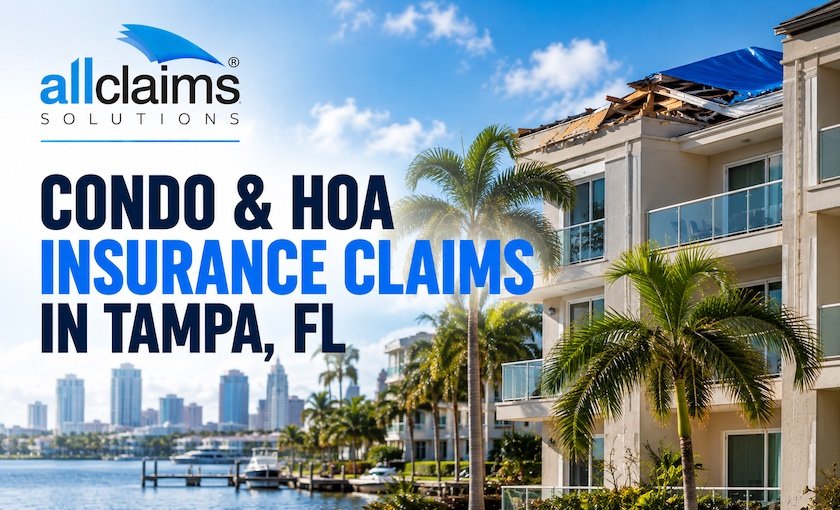
What Condo Associations, HOA Boards, and Property Owners Need to Know
When a condominium community or homeowners association in Tampa suffers property damage, filing an insurance claim can be significantly more complicated than a typical residential claim.
A single storm, hurricane, plumbing failure, fire, or roof loss can affect common areas, buildings, individual units, association property, personal property, and even the financial operations of the community.
Determining who is responsible for the damage—and which insurance policy should respond—can become one of the most important parts of the claim.
For condominium associations, HOA boards, property managers, and individual unit owners, understanding the difference between association coverage and individual property coverage is essential.
At All Claims Solutions, we help Tampa property owners and associations navigate complex property insurance claims involving storm damage, water damage, roof damage, fire, structural damage, and other covered losses.
How Condo and HOA Insurance Claims Work in Tampa
Condominium and HOA insurance claims can involve multiple parties and multiple insurance policies.
Depending on the property and circumstances, a claim may involve:
- The condominium association
- HOA or community association
- Individual unit owners
- Property management companies
- Insurance carriers
- Contractors
- Engineers
- Restoration companies
- Public adjusters
The first question is often:
Who is responsible for the damaged property?
That answer can depend on:
- Florida law
- The association’s governing documents
- The condominium declaration
- Maintenance responsibilities
- The association’s master insurance policy
- The individual owner’s policy
- The cause of the damage
For condominium properties, Florida law establishes specific insurance responsibilities for associations and unit owners.
For HOAs, responsibilities can depend more heavily on the association’s governing documents, insurance policy, and the nature of the property involved.
Condo Association Insurance vs. Individual Condo Insurance
One of the most important distinctions for Tampa condominium owners is the difference between the association’s master insurance policy and the owner’s individual HO-6 policy.
Florida DFS explains that an HO-6 condominium unit-owner policy primarily covers personal property, liability, and certain building items that are not insured by the association’s policy.
The Association’s Insurance
For a condominium association, the master policy can cover certain portions of:
- Common elements
- Association property
- Building structures
- Roofs
- Exterior components
- Certain originally installed building elements
- Other property required to be insured by the association
Florida law specifically requires condominium associations to maintain adequate property insurance and establishes certain primary coverage responsibilities.
The Unit Owner’s HO-6 Policy
The individual unit owner’s policy can cover items such as:
- Personal belongings
- Furniture
- Electronics
- Certain interior improvements
- Certain building components
- Appliances
- Cabinets
- Flooring and wall coverings, depending on the policy and circumstances
- Personal liability
- Loss assessment coverage
Florida DFS notes that an HO-6 policy must provide at least $2,000 of loss assessment coverage, subject to the requirements and conditions described by the department.
The exact responsibility depends on the applicable law, governing documents, and insurance policies.
What Is a Condo Master Insurance Policy?
A condominium association’s master policy is generally designed to insure property for which the association has insurance responsibility.
Florida Statute contains specific requirements for condominium association insurance, including adequate property insurance and primary coverage for certain condominium property.
However, the master policy does not mean that every item inside every unit is automatically covered by the association.
Florida DFS specifically identifies certain items that are excluded from the association’s required primary coverage, including:
- Personal property inside the unit
- Floor coverings
- Wall coverings
- Ceiling coverings
- Appliances
- Water heaters
- Built-in cabinets and countertops
- Electrical fixtures
- Window treatments
- Certain replacements of these items
These items can fall under the individual unit owner’s responsibility depending on the circumstances and applicable coverage.
This distinction is extremely important when evaluating a condominium insurance claim.
What Types of Damage Can Affect a Tampa Condo or HOA?
Condominium and HOA communities can experience many of the same property losses as individual homes, but the scale and responsibility can be very different.
Common claims include:
Storm Damage
Tampa storms can damage:
- Roofs
- Exterior walls
- Windows
- Common buildings
- Pool areas
- Fences
- Landscaping
- Clubhouses
- Community facilities
Hurricane Damage
A hurricane can affect an entire community simultaneously.
Potential losses can include:
- Roofing systems
- Exterior structures
- Common areas
- Pool enclosures
- Windows
- Landscaping
- Electrical systems
- Water intrusion
- Interior building damage
Water Damage
Water losses can originate from:
- Plumbing failures
- Burst pipes
- Roof leaks
- HVAC systems
- Sprinkler systems
- Appliances
- Drainage problems
The difficult question may be determining which property was damaged and who is responsible for it.
Fire Damage
A fire can affect:
- Individual units
- Common areas
- Hallways
- Clubhouses
- Electrical systems
- Roofs
- Structural components
- Personal property
Smoke, soot, and firefighting water can create additional damage.
Roof Damage
Roof claims are particularly important for condominium associations because the roof may protect an entire building.
A roof loss can potentially create:
Roof damage → Water intrusion → Interior damage → Unit damage → Mold concerns
This can involve multiple claims or insurance responsibilities.
Who Is Responsible for a Condo Insurance Claim?
This is one of the most common questions after a condominium loss.
The answer isn’t always simple.
For example, imagine a storm damages the roof of a Tampa condominium building.
Rain enters the building and damages:
- The ceiling
- Walls
- Flooring
- Cabinets
- Furniture
The association may have insurance responsibilities for portions of the building, while the individual unit owner may have separate coverage for certain interior items or personal property.
Florida law establishes specific condominium insurance responsibilities, but the actual claim must still be evaluated against the governing documents and applicable policies.
What About HOA Insurance Claims?
Homeowners associations are different from condominiums.
An HOA generally operates within a community of individually owned parcels, and insurance responsibilities can depend on:
- The HOA’s governing documents
- Declaration of covenants
- Maintenance responsibilities
- Association-owned property
- Common areas
- Insurance policies
- The cause of the damage
Florida’s Chapter 720 governs homeowners’ associations, while condominium associations are governed under Chapter 718.
This distinction matters because a homeowners association should not automatically assume that the insurance rules applicable to a condominium association apply in exactly the same way to its community.
Common HOA Property That May Be Involved in a Claim
Depending on the community, an HOA claim may involve:
- Clubhouses
- Community centers
- Pool facilities
- Pool enclosures
- Gates
- Fences
- Roads
- Sidewalks
- Landscaping
- Irrigation systems
- Street lighting
- Mail structures
- Recreational facilities
- Association-owned buildings
Whether a particular item is covered depends on the association’s policy and governing documents.
What Should a Condo Association or HOA Do After Property Damage?
A public adjuster represents the policyholder, not the insurance company.
When an association experiences significant property damage, the board should take organized steps to protect the property and document the loss.
1. Protect Residents and the Property
Safety should come first.
If the damage creates electrical, structural, fire, or other hazards, follow instructions from emergency personnel and qualified professionals.
2. Document the Damage
Take photographs and videos of:
- Exterior damage
- Roof damage
- Common areas
- Building interiors
- Hallways
- Mechanical systems
- Pool facilities
- Landscaping
- Association property
- Water intrusion
- Damaged equipment
Document the condition before permanent repairs whenever reasonably possible.
3. Notify the Insurance Company
Follow the reporting requirements of the association’s insurance policy.
Keep copies of:
- Claim numbers
- Emails
- Letters
- Inspection reports
- Estimates
- Adjuster communications
- Photos
- Videos
4. Review the Association’s Insurance Policy
The board should understand:
- Covered causes of loss
- Exclusions
- Deductibles
- Coverage limits
- Replacement-cost provisions
- Wind coverage
- Flood coverage
- Ordinance or law coverage
- Additional endorsements
For condominium associations, Florida law requires adequate property insurance and provides specific requirements concerning replacement cost and association property.
5. Review the Governing Documents
Insurance responsibility can also be affected by:
- Declaration
- Bylaws
- Association rules
- Maintenance provisions
- Repair responsibilities
- Unit boundaries
- Common-element definitions
This is particularly important when damage affects both common elements and individual units.
6. Preserve Damaged Property
Don’t immediately discard damaged equipment, materials, or other property.
Whenever practical:
Document → Preserve → Notify → Evaluate
before disposing of significant damaged property.
Condo Insurance Claims and Water Damage
Water damage can be particularly complicated in condominium communities.
Consider this example:
A pipe fails inside one unit.
Water spreads into:
- The unit
- The hallway
- The unit below
- Common areas
- Building materials
The claim may involve questions about:
Cause → Maintenance responsibility → Building damage → Unit damage → Personal property
The association and affected unit owners may have different insurance responsibilities.
👉 Related resource: [Water Damage Insurance Claims in Tampa, FL]
Condo Roof Damage Insurance Claims
Roof damage is another major concern for condominium communities.
A damaged roof can create widespread water intrusion.
Potential damage may include:
- Roofing materials
- Roof decking
- Insulation
- Ceilings
- Walls
- Flooring
- Electrical systems
- Personal property
For condominium associations, Florida law specifically addresses insurance responsibilities for condominium property, including certain building components.
👉 Related resource: [Roof Damage Claims Tampa FL: Everything Property Owners Need to Know]
Hurricane and Storm Damage to Condos and HOAs
A major storm can create a community-wide insurance claim.
For example:
Hurricane
↓
Roof and exterior damage
↓
Water intrusion
↓
Interior building damage
↓
Unit and contents damage
↓
Common-area damage
↓
Potential additional expenses
The association may need to coordinate inspections, emergency mitigation, contractors, engineers, and insurance representatives.
Tampa’s exposure to hurricanes and severe storms makes a well-organized claims process particularly important for community associations.
👉 Related resource: [Hurricane Damage Claims in Tampa]
What Is Loss Assessment Coverage?
Loss assessment coverage is particularly relevant to condominium unit owners.
Florida DFS explains that HO-6 policies include loss assessment coverage and that Florida law requires at least $2,000 of such coverage, with a deductible no greater than $250. The coverage can help with an owner’s share of certain covered losses involving common property, subject to the policy’s terms and applicable peril.
For example, an association may experience a covered loss involving common property and assess unit owners for certain amounts.
Whether the individual owner’s loss assessment coverage responds depends on the specific circumstances and policy.
What If the Association’s Insurance Is Not Enough?
A significant property loss can exceed available insurance coverage.
Florida condominium law addresses situations involving association deductibles and damages in excess of property insurance coverage. Under §718.111, such amounts are generally treated as common expenses, subject to statutory exceptions.
This is one reason boards need to understand:
- Policy limits
- Deductibles
- Replacement costs
- Reserve funds
- Coverage gaps
- Potential assessments
The financial consequences of a major claim can extend well beyond the initial insurance payment.
What If the Insurance Company Underpays the Association’s Claim?
An insurance company may acknowledge that damage occurred while disagreeing about:
- Scope
- Repair methodology
- Replacement costs
- Building components
- Code-related work
- Roofing costs
- Interior repairs
- Common-area damage
- Equipment
- Other covered property
A detailed claim file can help identify differences between the documented loss and the insurer’s estimate.
👉 Related resource: [Why Insurance Claims Get Underpaid in Tampa, FL]
What If a Condo or HOA Insurance Claim Is Denied?
A denied association claim can have serious consequences because the loss may affect an entire community.
A denial may involve disputes concerning:
- Cause of loss
- Policy exclusions
- Maintenance
- Wear and tear
- Coverage limits
- Deductibles
- Documentation
- Property responsibility
The association should carefully review the insurer’s explanation and applicable policy language.
Professional claim assistance may be appropriate when a claim is large, complex, or disputed.
👉 Related resource: [Denied Insurance Claim Help in Tampa, FL]
How a Public Adjuster Can Help a Tampa Condo or HOA
A public adjuster represents the policyholder, not the insurance company.
For a condominium association or HOA, a public adjuster may assist with:
- Inspecting and documenting damage
- Organizing claim documentation
- Reviewing the scope of loss
- Preparing estimates
- Identifying potentially overlooked damage
- Documenting common-area damage
- Organizing contents and equipment losses
- Communicating with the insurance company
- Presenting the claim
- Assisting with disputed or underpaid claims
Florida DFS states that public adjusters can assist policyholders with claim documentation, filing requirements, and presenting claims to insurers. Public adjusters must be licensed in Florida.
For a large community loss, professional claim management can help the board stay organized while dealing with residents, property managers, contractors, and insurance representatives.
When Should a Condo Association Consider Hiring a Public Adjuster?
There is no single answer for every loss.
Professional claim assistance may be worth considering when:
- The damage is extensive
- Multiple buildings are affected
- The roof is involved
- There is significant water intrusion
- Common areas are damaged
- The claim involves multiple insurance issues
- The insurer disputes the scope of damage
- The claim has been underpaid
- The claim has been denied
- Business or community operations are significantly disrupted
The association should also verify licensing and carefully review the public adjuster’s contract before signing.
Commercial Property Claims vs. Condo Association Claims
A condominium association claim can resemble a commercial property claim in complexity, but there are important differences.
A commercial property owner generally owns the building and operates a business from it.
A condominium association may be responsible for:
Common elements + association property + certain building components
while individual unit owners may separately insure:
Personal property + certain interior components + liability
Florida DFS notes that commercial property policies can include different coverage forms, causes of loss, deductibles, limits, and endorsements.
This makes it especially important to identify whose policy applies to which portion of the loss.
Condo & HOA Insurance Claim Checklist
If your Tampa condominium or HOA experiences property damage:
Immediately After the Loss
☐ Protect residents and occupants
☐ Address emergency safety issues
☐ Photograph the damage
☐ Record videos
☐ Document the date and circumstances of the loss
☐ Prevent additional damage
Association Documentation
☐ Locate the master insurance policy
☐ Review the declarations page
☐ Review deductibles
☐ Review coverage limits
☐ Gather governing documents
☐ Identify maintenance responsibilities
☐ Gather prior inspection reports
Property Documentation
☐ Document common areas
☐ Document buildings
☐ Document roofs
☐ Document equipment
☐ Document landscaping
☐ Document pools and recreational facilities
☐ Document affected units
Claim Documentation
☐ Notify the insurance company
☐ Obtain the claim number
☐ Keep all communications
☐ Gather estimates
☐ Obtain inspection reports
☐ Preserve damaged property when practical
☐ Track emergency expenses
Claim Review
☐ Compare the insurer’s estimate with the documented damage
☐ Identify potentially overlooked damage
☐ Review exclusions and deductibles
☐ Document additional damage
☐ Evaluate whether professional claim assistance is appropriate
All Claims Solutions — Trusted Commercial Public Adjusters Serving Tampa, FL.
 201 E. Kennedy Blvd #1240, Tampa, FL 33602
 24/7 Assistance: (813) 368-5382
 tampa.allclaimssolutions.com
Frequently Asked Questions About Condo & HOA Insurance Claims in Tampa
Florida law requires residential condominium associations to maintain adequate property insurance, subject to the requirements of Florida Statute
No. A condominium association’s master policy and the individual unit owner’s HO-6 policy generally cover different categories of property. Florida DFS specifically identifies certain items within units that are excluded from the association’s required primary coverage.
An HO-6 policy generally provides coverage for personal property, liability, and certain building items not insured by the condominium association’s policy.
Loss assessment coverage can help an individual condominium owner with certain assessments arising from covered losses affecting common property, subject to the policy terms and applicable limits. Florida law requires at least $2,000 of loss assessment coverage in an HO-6 policy, subject to statutory conditions.
Not necessarily. Condominium associations are governed by Chapter 718, which contains specific insurance requirements. HOAs are generally governed by Chapter 720, and their insurance responsibilities can depend on governing documents, association property, and the applicable insurance policy.
It depends on the damaged property, the cause of loss, the association’s responsibilities, the governing documents, and the applicable insurance policies. The association’s master policy and the unit owner’s HO-6 policy may each respond to different portions of a loss.
The condominium association generally has important insurance responsibilities for covered condominium property, including certain building components. The specific claim must be evaluated against Florida law, the association’s governing documents, and the applicable policy.
The board should compare the insurer’s estimate with the documented scope of damage and supporting estimates. For complex or disputed losses, professional claim assistance may help the association evaluate and present the claim.
Yes. A licensed public adjuster may assist the association with documenting damage, preparing the claim, organizing estimates, and presenting the claim to the insurance company.
Get Help With a Condo or HOA Insurance Claim in Tampa, FL
A property insurance loss affecting a condominium or HOA can become complicated quickly.
The claim may involve:
Association property + common areas + individual units + personal property + deductibles + potential assessments
Understanding which policy applies to which portion of the damage is an important part of the claims process.
If your Tampa condominium association, HOA, or property has suffered storm, hurricane, roof, water, fire, or other property damage, All Claims Solutions can help you evaluate the loss and navigate the insurance claims process.
Get Your Free Insurance Claim Evaluation
If your association is dealing with a complex property loss, an underpaid claim, a denied claim, or questions about the scope of damage, contact All Claims Solutions to discuss your situation.
Call All Claims Solutions today for a free claim evaluation.
This article is for general informational purposes only and does not constitute legal, accounting, or insurance coverage advice. Property insurance coverage varies by policy, insurer, endorsements, exclusions, limits, deductibles, and the circumstances of the loss.
Types of Insurance Claims in Tampa FL
Water Damage >
Fire Damage >
Storm Damage >
Flood Damage >
Mold damage >
Structural Damage >