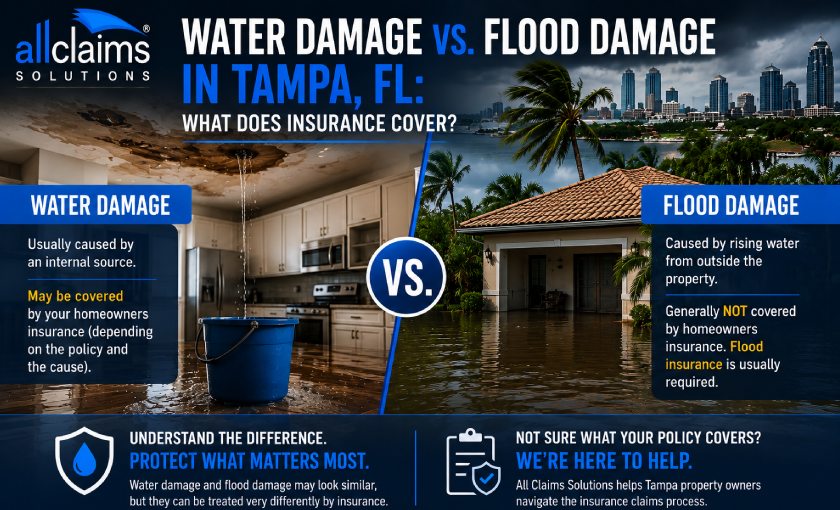
Water damage and flood damage may look similar after a storm, but they can be treated very differently by insurance policies.
For Tampa property owners, understanding the difference can be especially important. Tampa experiences heavy rainfall, tropical storms, hurricanes, localized flooding, and other events that can introduce large amounts of water into a property. The City of Tampa notes that intense rainstorms can cause localized flooding and that flood risk can increase significantly during tropical storms and hurricanes.
One of the most important questions after water enters your property is:
Is this water damage or flood damage—and which insurance policy may cover it?
The answer depends on where the water came from, how it entered the property, the specific insurance policy, and the circumstances of the loss.
At All Claims Solutions, our Public Adjusters help Tampa homeowners, business owners, and property owners document property damage and navigate the insurance claims process.
We work for you—not the insurance company.
Water Damage vs. Flood Damage: Why the Difference Matters
The terms water damage and flood damage are often used interchangeably in everyday conversation.
From an insurance perspective, however, they can mean very different things.
A sudden burst pipe inside your home may create a water damage claim under a homeowners policy, depending on the policy and circumstances.
Water entering your property because of rising surface water, overflowing waterways, or other conditions that meet the policy’s definition of a flood may instead require flood insurance.
The Florida Department of Financial Services explains that most homeowners policies do not include flood coverage and that flood insurance is generally purchased separately or through an applicable endorsement.
The source and cause of the water matter.
What Is Water Damage?
Water damage generally refers to damage caused by water from a specific source affecting the property.
Examples can include:
- Burst pipes
- Broken plumbing
- Appliance leaks
- Water heater failures
- HVAC leaks
- Toilet or bathroom leaks
- Certain roof leaks
- Accidental discharge of water
- Water entering through a storm-damaged roof
Whether the resulting damage is covered depends on the specific insurance policy and circumstances.
What Is Flood Damage?
Flood insurance uses a specific definition of “flood.”
The Florida Department of Financial Services explains that flood generally involves a general and temporary inundation of normally dry land affecting two or more acres or two or more properties, with certain specified sources such as overflowing inland or tidal waters or unusual and rapid accumulation or runoff of surface water.
Examples of situations that may involve flood damage include:
- Rising water
- Storm surge
- Overflowing rivers
- Overflowing lakes
- Surface water runoff
- Certain tropical-storm-related flooding
- Water entering from outside the structure as a result of flooding
The exact determination depends on the applicable flood policy and circumstances.
Does Homeowners Insurance Cover Flood Damage in Tampa?
Generally, standard homeowners insurance does not cover flood damage.
The City of Tampa specifically states that homeowners insurance policies usually do not cover damage caused by floods and points property owners toward separate flood insurance through the National Flood Insurance Program (NFIP).
The Florida Department of Financial Services similarly states that standard homeowners insurance does not cover flood damage and explains that flood insurance can be obtained through the NFIP or private insurers.
This distinction can become extremely important after a hurricane.
For example:
Hurricane → Storm Surge → Rising Water → Property Damage
may involve flood coverage.
But:
Hurricane → Wind Damage to Roof → Rain Enters Through Opening → Interior Damage
may involve a different insurance analysis.
The actual policy and circumstances should be reviewed before determining coverage.
Does Homeowners Insurance Cover Water Damage?
It may, depending on the cause of the water damage and the terms of the policy.
Potentially covered scenarios can include certain sudden and accidental events such as:
- A burst pipe
- A sudden plumbing failure
- A water heater failure
- A sudden appliance leak
- Certain storm-related roof leaks
However, coverage can be affected by:
- Policy exclusions
- Wear and tear
- Long-term leaks
- Maintenance issues
- Negligence
- Flooding
- Sewer backup
- Mold
- Other policy limitations
The Florida Department of Financial Services notes, for example, that water-backup coverage may require a specific endorsement and that this coverage does not provide coverage for flood damage.
Water Damage vs. Flood Damage: Examples
Understanding the difference becomes easier with real-world examples.
Example 1: Burst Pipe
A pipe suddenly breaks inside a Tampa home.
Water spreads through the kitchen and damages:
- Cabinets
- Flooring
- Drywall
- Baseboards
This may be considered a water damage claim under the homeowners policy, depending on the policy and circumstances.
Example 2: Storm Surge
A hurricane causes storm surge and rising water enters the home.
This may fall under the definition of flood and generally requires applicable flood insurance rather than standard homeowners coverage.
Example 3: Roof Damage During a Hurricane
High winds damage the roof.
Rain then enters through the opening and damages the ceiling and walls.
This scenario can be more complicated because the loss may involve:
Wind Damage → Roof Damage → Rain Intrusion → Interior Water Damage
The applicable policy provisions and cause of loss need to be evaluated.
Example 4: Heavy Rain and Surface Water
A severe Tampa rainstorm causes water to accumulate outside the property and eventually enter the building.
Depending on the circumstances and policy definition, this could potentially raise a flood-coverage issue rather than a standard water-damage claim.
Why Tampa Property Owners Should Understand Flood Risk
Tampa’s geography and weather patterns make understanding flood risk particularly important.
The City of Tampa notes that intense rainstorms can cause localized flooding because water may not drain quickly in certain areas. During tropical storms and hurricanes, flooding can become more widespread and intense.
The City also provides flood-zone information and recommends that property owners understand their flood zone and evacuation zone.
Importantly:
Your flood zone and evacuation zone are not the same thing.
A property owner’s flood risk should therefore be considered independently from whether they are located in a designated evacuation zone.
Can You Have Water Damage and Flood Damage From the Same Storm?
Yes.
This is one of the most important concepts for Tampa property owners.
A single hurricane or severe weather event can produce multiple causes of damage.
For example:
Scenario:
A hurricane hits Tampa.
Step 1: High winds damage the roof.
Step 2: Rain enters through the damaged roof.
Step 3: Water damages the ceiling and drywall.
Step 4: Storm surge or rising floodwater later enters the property.
Now the property may have different categories of damage with potentially different insurance implications.
That’s why simply saying “my house was damaged by a hurricane” may not tell the entire story.
A proper claim evaluation should examine how each portion of the damage occurred.
What Should You Do If Water Enters Your Tampa Property?
If your property experiences water intrusion, take organized steps as soon as reasonably possible.
1. Protect Everyone First
Do not enter areas that may present electrical, structural, or other safety hazards.
2. Stop the Source When Safe
If the source is a broken pipe or plumbing failure, turn off the water supply when appropriate and contact a qualified professional.
3. Take Photos and Videos
Document:
- Where the water entered
- The source of the water
- Walls
- Ceilings
- Floors
- Cabinets
- Personal property
- Exterior areas
- Roof damage
- Standing water
- Other visible damage
Whenever reasonably possible, document the condition before permanent repairs or disposal of damaged materials.
4. Prevent Additional Damage
Take reasonable steps to mitigate further damage when safe and appropriate.
Keep:
- Receipts
- Invoices
- Emergency service records
- Contractor documentation
- Photographs
5. Notify Your Insurance Company
Follow your policy’s requirements for reporting the loss.
Keep a record of your:
- Claim number
- Date reported
- Insurance adjuster’s information
- Communications
- Estimates
- Inspection reports
What If the Insurance Company Says It’s Flood Damage?
This can be a major point of disagreement in a water damage claim.
If your insurance company determines that the damage resulted from flooding, review:
- The explanation provided by the insurer
- The applicable policy provisions
- The documented source of the water
- Photographs and videos
- Inspection reports
- The timeline of the event
- Any applicable flood insurance policy
The question isn’t simply:
“Was there water?”
The important question is:
“Where did the water come from, and what caused it to enter the property?”
What If the Water Damage Claim Is Denied?
An insurance company may dispute a water damage claim for several reasons.
For example, the insurer may argue that the damage resulted from:
- Flooding
- Long-term seepage
- Wear and tear
- Lack of maintenance
- An excluded cause
- Pre-existing damage
- Sewer backup
- Another policy exclusion
A denial does not automatically answer every question about the loss.
Property owners should carefully review the denial and the policy provisions cited by the insurance company.
A licensed Public Adjuster can help evaluate the documented property damage and assist with the claims process.
What About Mold After Water Damage?
Water that remains inside building materials can create conditions that contribute to mold growth.
Potentially affected areas include:
- Drywall
- Insulation
- Flooring
- Cabinets
- Walls
- Ceilings
- Carpeting
Mold coverage can vary significantly depending on the policy and circumstances.
The most important step is identifying and documenting the source of the moisture.
For example:
Covered Water Event → Water Intrusion → Moisture → Mold
The cause of the original water loss may be relevant when evaluating the resulting claim.
What About Sewer Backup?
Sewer backup is another situation that can be confused with flood damage.
The Florida Department of Financial Services explains that water-backup coverage may be available through a policy endorsement and that this type of coverage does not provide coverage for flood damage.
If sewage or water backs up into your property, determine:
- Where the water came from
- What caused the backup
- Whether you have a water-backup endorsement
- Whether flood conditions were also involved
Commercial Properties: Water vs. Flood Damage
The distinction is also important for Tampa businesses.
A commercial property may experience:
- Plumbing failures
- Roof leaks
- Storm damage
- Flooding
- Equipment damage
- Inventory loss
- Building damage
- Business interruption
For commercial property owners, the claim may involve both physical property damage and financial losses associated with business interruption, depending on the applicable policy.
This is why commercial property claims should be evaluated comprehensively rather than focusing only on visible building damage.
What If My Property Is in a Tampa Flood Zone?
Being located in a flood zone is an important consideration when evaluating flood risk and insurance needs.
The City of Tampa provides flood-zone information and explains that FEMA flood maps are used to identify flood hazards and help determine flood insurance and building requirements.
However, property owners should not assume that being outside a designated high-risk flood zone means flooding cannot occur.
The City notes that localized flooding can occur in Tampa during intense rainfall.
Flood risk and insurance coverage are not the same question.
Your property’s risk profile and the terms of your insurance policies should both be considered.
How a Public Adjuster Can Help With Water or Flood-Related Claims
A Public Adjuster represents the policyholder, not the insurance company.
For a complicated water-related claim, a Public Adjuster may assist with:
Property Inspection
Evaluating visible damage and identifying areas requiring further investigation.
Damage Documentation
Organizing photographs, measurements, estimates, and other supporting documentation.
Cause-of-Loss Documentation
Helping organize evidence regarding how the damage occurred.
Policy Review
Reviewing the applicable property insurance policy and identifying relevant coverage, exclusions, and deductibles.
Claim Preparation
Helping prepare documentation describing the scope of the loss.
Insurance Communication
Assisting with claim-related communication.
Negotiation
Representing the policyholder during discussions concerning the documented loss.
Why All Claims Solutions Can Help
When water enters your property, figuring out whether you’re dealing with water damage, flood damage, storm damage, or a combination of losses can be confusing.
At All Claims Solutions, our Public Adjusters help Tampa property owners navigate the insurance claims process.
Our approach focuses on:
INSPECT
↓
DOCUMENT
↓
REVIEW
↓
PREPARE
↓
PRESENT
↓
NEGOTIATE
We Work for You—not the Insurance Company.
No Recovery – No Fee.
We serve homeowners, business owners, commercial properties, condominiums, and other property owners throughout Tampa and surrounding Gulf Coast communities.
How Long Do You Have to File a Water or Flood-Related Insurance Claim in Florida?
Florida’s current property insurance statute generally provides that a claim or reopened claim must be reported within one year after the date of loss, while a supplemental claim must generally be reported within 18 months, subject to the applicable policy and statutory requirements. For certain weather-related losses, the statute specifies how the date of loss is determined.
Because deadlines and policy requirements matter, property owners should avoid waiting until the last minute to report a loss or address newly discovered damage.
If you have experienced property damage, act promptly and review your specific policy.
All Claims Solutions — Trusted Commercial Public Adjusters Serving Tampa, FL.
 201 E. Kennedy Blvd #1240, Tampa, FL 33602
 24/7 Assistance: (813) 368-5382
 tampa.allclaimssolutions.com
Frequently Asked Questions
It may be, depending on the cause of the damage and the specific policy. Sudden and accidental water losses may be treated differently from flooding, long-term leaks, or excluded causes.
Generally, standard homeowners insurance does not cover flood damage. Separate flood insurance may be necessary.
The key difference is often the source and cause of the water. A burst pipe inside a property and rising surface water from flooding can have very different insurance implications.
Flood insurance covers qualifying direct physical losses caused by a flood as defined by the applicable policy. It does not automatically cover every type of water damage.
Storm surge is generally associated with flooding and is typically not covered by a standard homeowners policy. Applicable flood insurance may provide coverage, subject to its terms.
A sudden and accidental pipe failure may be covered depending on the policy and circumstances. Damage related to long-term deterioration or maintenance issues may be treated differently.
Review the insurer’s explanation, the policy language, and the evidence showing where the water came from. A licensed Public Adjuster may be able to help evaluate and document the property damage.
A Public Adjuster can assist with claims involving policies they are authorized to adjust, including documenting property damage and representing the policyholder in the claims process. Whether they can assist with a particular flood policy depends on the policy and circumstances.
Get Help With a Water Damage Insurance Claim in Tampa, FL
Water damage can become complicated quickly.
A single storm can create:
Wind Damage → Roof Damage → Rain Intrusion → Water Damage
or:
Heavy Rain → Surface Water → Flooding → Property Damage
Understanding the difference can be critical when determining which insurance coverage may apply.
If your Tampa home, condo, commercial property, or business has suffered water-related damage, All Claims Solutions can help you navigate the insurance claims process.
Don’t navigate a complicated property insurance claim alone.
All Claims Solutions – Tampa Public Adjusters
We Work for You—not the Insurance Company.
No Recovery – No Fee.
24/7 Service
This article is provided for general informational purposes and does not constitute legal advice or a determination of insurance coverage. Coverage depends on the specific insurance policy and circumstances of each loss.
Types of Insurance Claims in Tampa FL
Water Damage >
Fire Damage >
Storm Damage >
Flood Damage >
Mold damage >
Structural Damage >