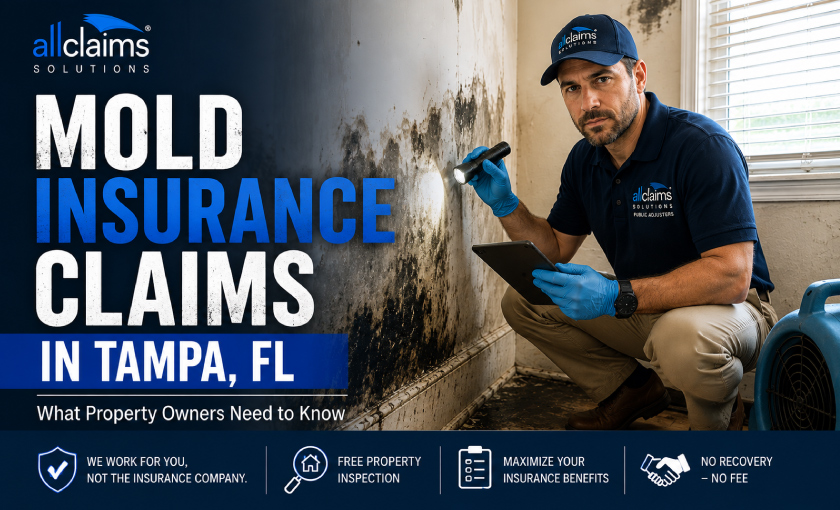
Mold can develop quickly after water enters a property, especially in Florida’s warm and humid climate. A plumbing leak, roof leak, storm, hurricane, or other water-related event can create the moisture conditions that allow mold to grow behind walls, under flooring, around appliances, and in other hidden areas.
For homeowners and property owners in Tampa, Florida, mold can create more than a property maintenance problem. It may also become part of an insurance claim, depending on the cause of the damage and the coverage provided by your policy.
At All Claims Solutions, our licensed Public Adjusters help property owners throughout Tampa document water and mold-related damage, review their insurance policies, prepare claims, and navigate the insurance claims process.
We work for you—not the insurance company.
Does Homeowners Insurance Cover Mold in Tampa, FL?
One of the most common questions property owners ask is:
“Does homeowners insurance cover mold?”
The answer depends on how the mold developed, what caused the underlying water damage, and what your insurance policy covers.
According to the Florida Department of Financial Services, mold resulting from a covered peril may be covered under a homeowners policy, but mold-related coverage is often subject to specific limits. Some insurers may also offer additional mold coverage through endorsements, while other policies may exclude certain mold-related claims.
For example, mold that develops following a sudden and accidental water loss, such as a burst pipe, may be treated differently from mold resulting from long-term maintenance issues or repeated moisture exposure.
That’s why property owners should review their actual policy rather than assuming that mold is automatically covered or excluded.
What Causes Mold Damage in Tampa Homes?
Tampa’s warm and humid environment can create favorable conditions for mold growth when moisture is present.
Common sources of moisture include:
Plumbing Leaks
Broken pipes, leaking supply lines, and plumbing failures can introduce water into walls, ceilings, flooring, and cabinets.
Roof Leaks
Damaged roofing materials can allow rainwater to enter the property and create hidden moisture.
Storm and Hurricane Damage
Wind and storm damage can create openings that allow water to enter a home or commercial property.
Appliance Leaks
Washing machines, refrigerators, water heaters, dishwashers, and other appliances can cause significant water damage if they fail.
HVAC Problems
Condensation, clogged drainage systems, or HVAC leaks can contribute to persistent moisture.
Water Damage That Wasn’t Properly Dried
If water remains inside walls, flooring, insulation, or other materials, mold can develop after the initial water loss.
Where Can Mold Hide?
Mold is not always visible.
It can develop in areas that are difficult to see, including:
- Behind drywall
- Under flooring
- Inside walls
- Behind cabinets
- Under carpets
- Around plumbing
- Behind appliances
- Inside HVAC systems
- In attics
- Around windows
- Inside ceilings
- In crawl spaces
The Florida Department of Financial Services specifically notes that mold can hide behind walls, under carpet, and behind appliances, making professional assessment important when moisture damage is suspected.
This is one reason why a property that appears relatively normal after a water loss may still have significant hidden damage.
Signs of Possible Mold Damage
Property owners should pay attention to signs that may indicate a moisture or mold problem.
These can include:
- Musty odors
- Visible mold growth
- Discoloration on walls or ceilings
- Peeling paint
- Bubbling drywall
- Warped flooring
- Persistent moisture
- Damp areas around plumbing
- Water stains
- Condensation
- Recurring leaks
A musty odor can sometimes indicate a moisture problem even when visible mold cannot be found.
What Types of Insurance Claims Can Lead to Mold Damage?
Mold may occur as a secondary consequence of another covered property loss.
For example:
Burst Pipe → Water Damage → Moisture → Mold
or:
Storm Damage → Roof Leak → Water Intrusion → Mold
or:
HVAC Leak → Hidden Moisture → Mold Growth
This is why a mold-related insurance claim should not necessarily be viewed as an isolated event.
The underlying cause of the moisture may be an important part of determining whether insurance coverage applies.
Mold After Water Damage: Why Documentation Matters
If your property experiences water damage, documenting the condition of the property as soon as possible is important.
Take photographs and videos of:
- The original water damage
- The source of the leak
- Wet materials
- Water stains
- Damaged flooring
- Damaged walls
- Visible mold
- Affected personal property
- Areas where emergency repairs were performed
Keep records of:
- Emergency repairs
- Water mitigation
- Drying equipment
- Cleaning
- Inspection reports
- Mold testing, if performed
- Remediation expenses
- Contractor estimates
- Communication with your insurance company
The Florida Department of Financial Services recommends detailed documentation and maintaining records and receipts throughout the claims process.
What Should You Do If You Discover Mold After Water Damage?
If you discover mold after a water-related loss, consider taking the following steps.
1. Identify the Source of Moisture
Mold remediation will not solve the underlying problem if water continues to enter the property.
The source could be:
- A plumbing leak
- Roof damage
- HVAC condensation
- Appliance failure
- Storm damage
- Another source of water intrusion
2. Document the Condition
Photograph and record the affected areas before significant remediation takes place whenever it is safe and practical to do so.
Document both the visible mold and the underlying water damage.
3. Take Reasonable Steps to Prevent Additional Damage
Emergency measures may be necessary to prevent the loss from becoming worse.
Keep receipts and records of these expenses.
Florida’s Homeowner Claims Bill of Rights advises policyholders to make and document necessary emergency repairs, keep receipts, and photograph or video damage before and after repairs.
4. Review Your Insurance Policy
Look for provisions relating to:
- Water damage
- Mold
- Fungus
- Wet or dry rot
- Remediation
- Additional coverage
- Endorsements
- Exclusions
- Coverage limits
Do not assume that every mold-related expense will automatically be covered.
5. Consider Professional Claim Assistance
If the water damage is extensive, mold has developed, or you are uncertain about your coverage, a licensed Public Adjuster can help evaluate and document the property loss.
Mold Insurance Claims and Water Damage Claims Are Often Connected
This is an important distinction for Tampa property owners.
A claim may involve several layers of damage:
Primary Damage
The original covered event.
Example: A burst pipe causes water to enter the home.
Secondary Damage
The water causes additional damage.
Example: Drywall, flooring, cabinets, and insulation become saturated.
Subsequent Damage
Moisture that remains can contribute to mold growth.
Example:
Burst Pipe → Water Damage → Hidden Moisture → Mold
A comprehensive evaluation can help determine the full scope of the property loss and which portions may be relevant to the insurance claim.
Can You File a Mold Insurance Claim After a Water Damage Claim?
Potentially.
If additional damage is discovered after an initial water damage claim, the appropriate process may depend on the status of the existing claim, the policy, the cause of the damage, and applicable deadlines.
Florida law currently distinguishes between initial claims, reopened claims, and supplemental claims, with different notice provisions. Under Florida Statutes §627.70132, the general notice period is one year for an initial or reopened claim and 18 months for a supplemental claim, subject to the statute and applicable policy provisions.
Because deadlines and coverage can depend on the circumstances, property owners should not wait unnecessarily after discovering additional damage.
Common Mold Insurance Claim Mistakes
Assuming All Mold Is Covered
Mold coverage varies significantly between policies.
Some policies may provide limited coverage, while endorsements may offer additional protection.
Ignoring the Original Water Damage
The cause of the moisture may be critical to understanding the insurance claim.
Waiting Too Long to Document the Damage
Mold can spread and conditions can change quickly.
Document the property as soon as reasonably possible.
Removing Everything Before Documentation
When safe and practical, photograph and document damaged materials and belongings before disposal or permanent repairs.
Focusing Only on Visible Mold
Hidden moisture can exist behind walls, beneath flooring, or in other concealed areas.
Assuming a Small Leak Means a Small Claim
A seemingly minor leak can create extensive damage if water enters concealed areas and remains there.
How a Public Adjuster Can Help With a Mold Insurance Claim
A Public Adjuster represents the policyholder during the insurance claims process.
For a complex water and mold loss, a Public Adjuster can help organize the claim and document the different components of the property damage.
At All Claims Solutions, our process may include:
Property Inspection
We evaluate the property for visible and potentially hidden damage associated with the loss.
Insurance Policy Review
We review the policy to identify applicable coverage, exclusions, limitations, and endorsements.
Damage Documentation
We organize photographs, reports, estimates, inventories, and other supporting documentation.
Claim Preparation
We help prepare a comprehensive presentation of the documented property loss.
Insurance Company Communication
We assist with claim-related communication and documentation.
Settlement Negotiation
We represent the policyholder during negotiations concerning the documented loss and applicable coverage.
Mold Insurance Claims for Commercial Properties in Tampa
Mold can also affect commercial buildings, offices, restaurants, warehouses, retail spaces, apartment buildings, and other properties.
Commercial mold-related losses may involve:
- Building damage
- Interior finishes
- Equipment
- Inventory
- Business personal property
- HVAC systems
- Tenant improvements
- Temporary relocation
- Business interruption
The applicable coverage depends on the commercial insurance policy and the circumstances surrounding the loss.
For businesses, properly documenting both property damage and operational impacts can be especially important.
Why Tampa Property Owners Choose All Claims Solutions
At All Claims Solutions, we help homeowners and business owners throughout Tampa navigate complex property insurance claims.
Our licensed Public Adjusters assist with:
- Water damage claims
- Mold-related claims
- Storm damage
- Hurricane damage
- Roof damage
- Fire damage
- Structural damage
- Commercial property claims
- Business interruption claims
Our approach focuses on thoroughly documenting the property loss and helping policyholders navigate the insurance claims process.
We Work for You—Not the Insurance Company.
All Claims Solutions — Trusted Commercial Public Adjusters Serving Tampa, FL.
 201 E. Kennedy Blvd #1240, Tampa, FL 33602
 24/7 Assistance: (813) 368-5382
 tampa.allclaimssolutions.com
Frequently Asked Questions About Mold Insurance Claims in Tampa
It depends on the policy and the cause of the mold. Mold resulting from a covered peril may be covered, but mold-related coverage is often limited or subject to specific exclusions and endorsements.
t may be, depending on the policy and circumstances. Florida’s Department of Financial Services gives a sudden and accidental water discharge from a burst pipe as an example of a covered peril that may result in mold coverage..
Coverage depends on the cause of the roof leak, the policy, and applicable exclusions or limitations. The underlying water damage and resulting mold should be evaluated together.
Potentially, but coverage and limits vary. Some policies may provide limited mold-related coverage, while endorsements may provide higher limits.
Yes. A licensed Public Adjuster can help document the property loss, review the applicable insurance policy, prepare claim documentation, and represent the policyholder during the claims process.
Document the newly discovered damage and notify the appropriate parties promptly. Depending on the circumstances, additional damage may need to be addressed through the existing claim or another claim process.
Get Help With a Mold Insurance Claim in Tampa, FL
Mold can be a sign of a much larger property damage problem.
Whether the moisture came from a burst pipe, roof leak, storm, hurricane, appliance failure, or another source, understanding the connection between the original damage and mold can be important when evaluating an insurance claim.
If your home or commercial property in Tampa, FL has suffered water or mold damage, All Claims Solutions can help you document the loss, review your policy, and navigate the insurance claims process.
Schedule Your Free Property Inspection
All Claims Solutions – Tampa Public Adjusters
We Work for You—not the Insurance Company.
No Recovery – No Fee.
Insurance coverage varies by policy and circumstances. This article is for general informational purposes and does not constitute legal or insurance coverage advice.
Types of Insurance Claims in Tampa FL
Water Damage >
Fire Damage >
Storm Damage >
Flood Damage >
Mold damage >
Structural Damage >